The manor
Scarsdale’s name comes from England. Caleb Heathcote, a younger son of a family from Chesterfield, in the Hundred of Scarsdale in Derbyshire, sailed for New York in the 1690s, prospered in trade and began buying land in Westchester. He bought claims to a strip running from Long Island Sound back to the Bronx River, and then bought “the Fox Meadow” from Native American chiefs, among them Cohawney.1
In 1701 King William III granted Heathcote a royal patent for the Manor of Scarsdale, named for his ancestral home.2 The English name means “dale of scars,” or rocks, which suited the land here too. It was one of nine royal manors in New York. The first count, in 1712, listed 12 people, seven of them enslaved. The manor was broken up in 1774, its tenants became owners, and Scarsdale became a town by state law on March 7, 1788.1
The Revolution passed through. After a skirmish near today’s Mamaroneck and Garden Roads, General Sir William Howe stayed in the Griffen farmhouse, which still stands with a bronze marker. A generation later James Fenimore Cooper, married to a great-granddaughter of Heathcote, lived on a farm on Mamaroneck Road and wrote The Spy here.1
The railroad
For its first half-century Scarsdale was small and agricultural: 281 people in the 1790 census and 255 in 1840, when all but four adult men worked the land. With no harbor or navigable river, it fell behind the Sound and Hudson towns.1 2
That changed in 1846, when the New York and Harlem Railroad began running through the Bronx River valley.1 Farmers could reach the city market, and well-off New Yorkers began building country estates. In 1856 Robert Purdy, a formerly enslaved man from Louisiana, bought five acres on Saxon Woods Road; the Village counts his family’s long presence as part of its foundations.2
The suburb itself began in 1891, when the Arthur Suburban Home Company bought a 150-acre farm and laid it out as one-family lots, with covenants barring commerce. That subdivision is Arthur Manor. By 1900 the population was 885.1 2
Incorporation, 1915
In 1915, residents voted 142 to 39 to become a village.
The motive was defensive. White Plains wanted to annex the Greenacres section, and a town’s borders could be changed by the State Legislature, while a village’s could change only by a vote of its own residents. Incorporating protected the map.1 3 Scarsdale then had almost 3,000 people. In 1930 the Town and the Village, which share the same borders, merged under one elected board that sits as both.4
Schools followed the growth: Scarsdale High School and Greenacres in 1917, Edgewood in 1918.1 In 1922 the Village adopted a village-wide zoning plan, which the Historical Society describes as the first zoning law passed in New York State by a suburban community. It has survived court challenges, and Scarsdale has stayed a town of single-family houses organized around its elementary schools.1 2
The Tudor village
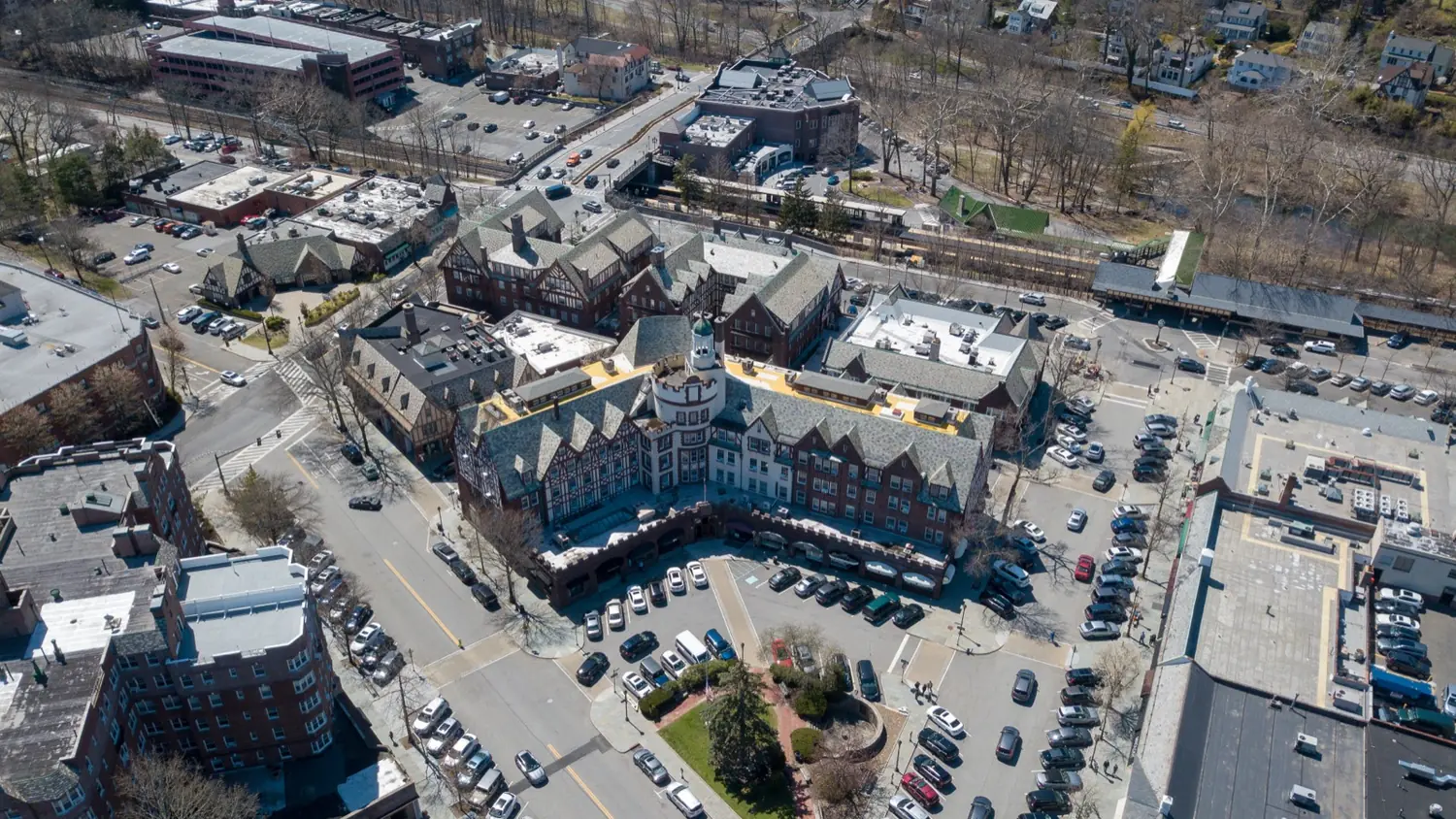
In the 1920s local business leaders built the Village Center beside the station in the Tudor Revival style, giving Scarsdale the look it still has.2 New stores and banks opened along East Parkway and Popham Road (the town’s first store had opened in 1912 at Popham and Garth Roads). The Bronx River Parkway, the first parkway in the country, opened in 1924.1
The same decade’s building boom tripled the population to 9,690. Fox Meadow and Crane-Berkley were developed, Heathcote’s Five Corners grew up around a railroad that didn’t last (the New York, Westchester and Boston), and Fox Meadow School opened in 1928. Many of the Tudor-style houses and storefronts date from these years.1
The non-partisan system
Scarsdale’s civic life was organized early. The Heathcote Association, the first neighborhood association, and the Town Club both formed in 1904. The Scarsdale Woman’s Club, organized in 1918, began publishing The Scarsdale Inquirer in 1919, and the League of Women Voters followed in 1921.1
Village elections run on a non-partisan system. Since the early 1930s a citizens’ Non-Partisan Committee has nominated candidates for village office, rather than political parties,5 part of what the Village calls a tradition of high community engagement.2 [Describe the current procedure (Citizens Nominating Committee, election) from a primary source before expanding this section]
Everyday Scarsdale
A second boom after World War II built out Quaker Ridge, named for its early Quaker settlers. Quaker Ridge School opened in 1947, Heathcote in 1953 and the junior high (now the middle school) in 1956. The Village and school district bought land for public use and open space, and added tennis and paddle courts, day camps and a pool complex.1 With almost all private land developed, the population has been fairly stable since; it was about 17,000 in 1990.1 [Add the 2020 Census population with a census.gov citation]
Today, the Village says, Scarsdale is known for its schools, its civic spirit and its access to New York City,2 which is more or less what the people who built it in the 1920s intended.
Continue: the village center today · the neighborhoods
Sources
- Scarsdale Historical Society, A Brief History of Scarsdale
- Village of Scarsdale, History
- Scarsdale Inquirer, March 27, 1915, “Incorporation Is Carried” (Hudson River Valley Heritage)
- Scarsdale10583, One Hundred Years in Scarsdale: From Manor to Village
- Scarsdale Inquirer, January 12, 1934, “The Non-Partisan Committee” (HRVH)
Curious about the history of a particular house or street?
Ask us →